
Thank you
Your message has been submitted. We will get back to you shortly.
Oops! Something went wrong while submitting the form.

Danish voice over with native Copenhagen-standard talent. The Scandinavian language where written similarity hides how differently it is actually spoken.
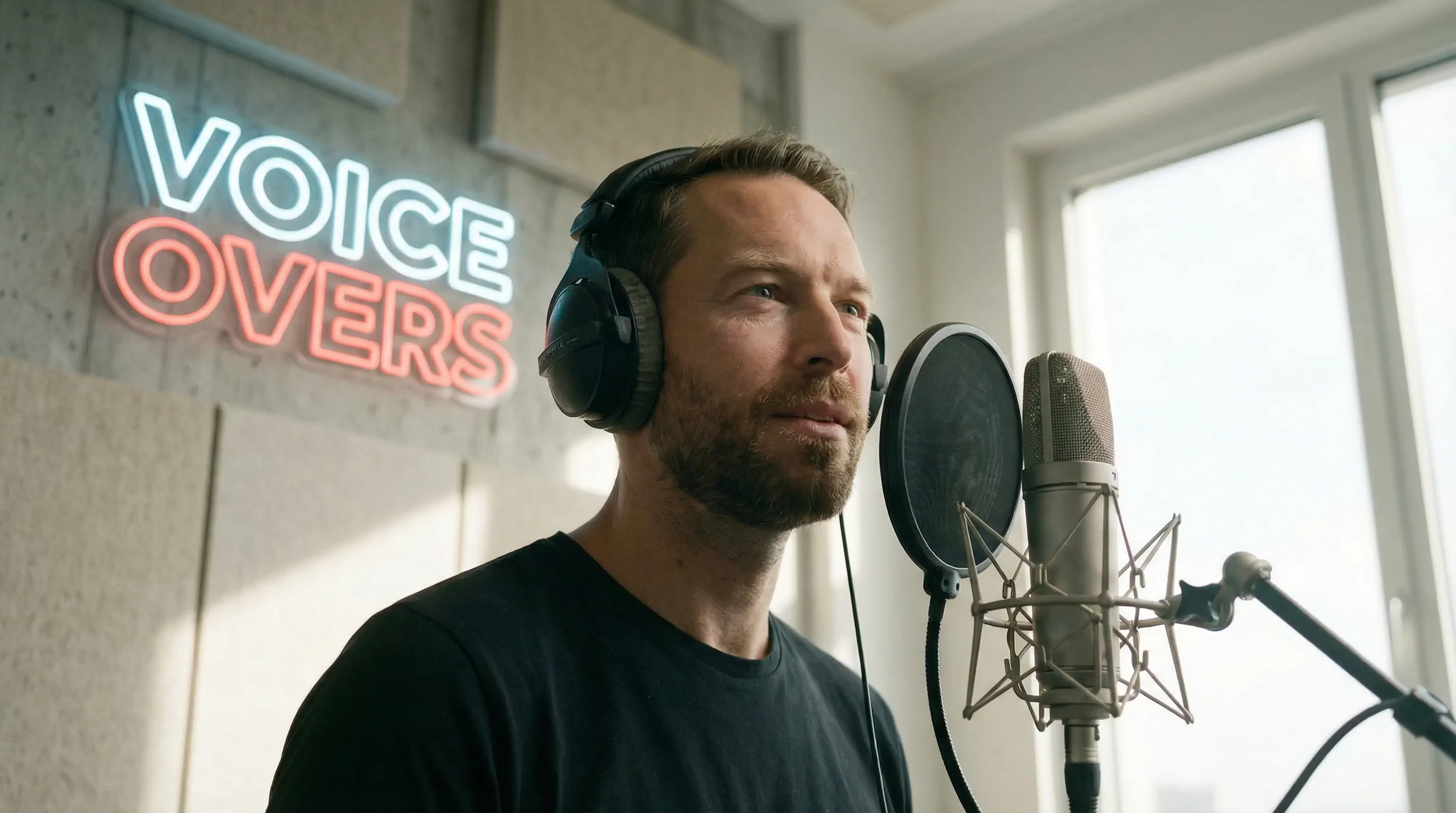
We provide complete voice-over production, managed from start to finish.
Have a question? Contact us at: info@voiceovers.com


Danish, Swedish and Norwegian look close enough on the page that international teams sometimes treat Scandinavia as one market with one budget line. Spoken, they are not interchangeable, and Danish is the one that diverges hardest.
Danish pronunciation reduces heavily: consonants soften or disappear, vowels blur, and the written form is a poor guide to the spoken one. Danes understand written Swedish and Norwegian more easily than they are understood in return. Practically, that means one Scandinavian recording does not cover three countries, and the assumption that it might is the most expensive planning error in this region.
Danish has stød, a glottal feature that distinguishes otherwise identical words. It is not a stress pattern and not a tone; it is a catch in the voice that Danes produce automatically and hear immediately when it is missing or misplaced.
Combined with the heavy reduction, it is why synthetic Danish remains one of the more obviously artificial European voices even as other languages have become convincing, and why a native check on delivered audio is worth more here than in most markets.
Standard Danish, centred on Copenhagen, is the broadcast norm and covers essentially all commercial work. Regional variation exists, most audibly in Jutland and on Funen, and it is cast deliberately for warmth or local authenticity rather than as a neutral alternative.
As in Sweden and Norway, the formal De has all but disappeared from commercial use. Du is correct for consumer, corporate and public-sector work alike, and a formal register carried over from a German or French source script should be removed rather than translated across. Danish advertising is also direct by international standards: superlatives and emotional build read as overselling rather than persuasion.
English proficiency is very high, so for B2B, technology and much online video the Danish version is optional. It stops being optional for consumer advertising, public sector, healthcare, children's content and anywhere sounding local is part of the trust. We will tell you when subtitling does the job for a fraction of the cost.
Danish expands only mildly against English, often 5 to 15 percent. Fixed durations usually survive with light adaptation at translation stage rather than a rewrite.
Send the script and tell us which Nordic markets it is for. Demos and a fixed quote usually within 24 hours, or see how hiring works.

